
Introduction to RibXcar
Search “snatched waist surgery” on social media and you’ll find dramatic before-and-afters, viral clips of the audible “clack” during rib reshaping, and bold claims about permanent hourglass results with no scars. The procedure behind most of these videos is called RibXcar — and while the marketing is loud, the underlying medical literature is now substantial enough to give patients a real, evidence-based picture of what it is, how it works, and what it actually costs in risk.
This article walks through the technique, its origin, and the safety data published in peer-reviewed plastic surgery journals — not the version filtered through a 30-second video.
Where RibXcar Came From
RibXcar was developed by Peruvian plastic surgeon Dr. Raúl Manzaneda Cipriani as a refinement of older rib-remodeling approaches, which had historically required larger incisions and carried a more significant recovery.
The technique was first performed in 2022 across Peru, Colombia, and Mexico, and was described in the surgical literature as a way to reshape the waistline via a puncture-based, ultrasound-guided monocortical fracture. This meant only the outer layer of the rib is fractured, not the full thickness of the bone, and the rib is not removed.
Since then, formal training courses have spread the technique internationally, including to plastic surgeons now practicing it in the United States.
How The Procedure Actually Works
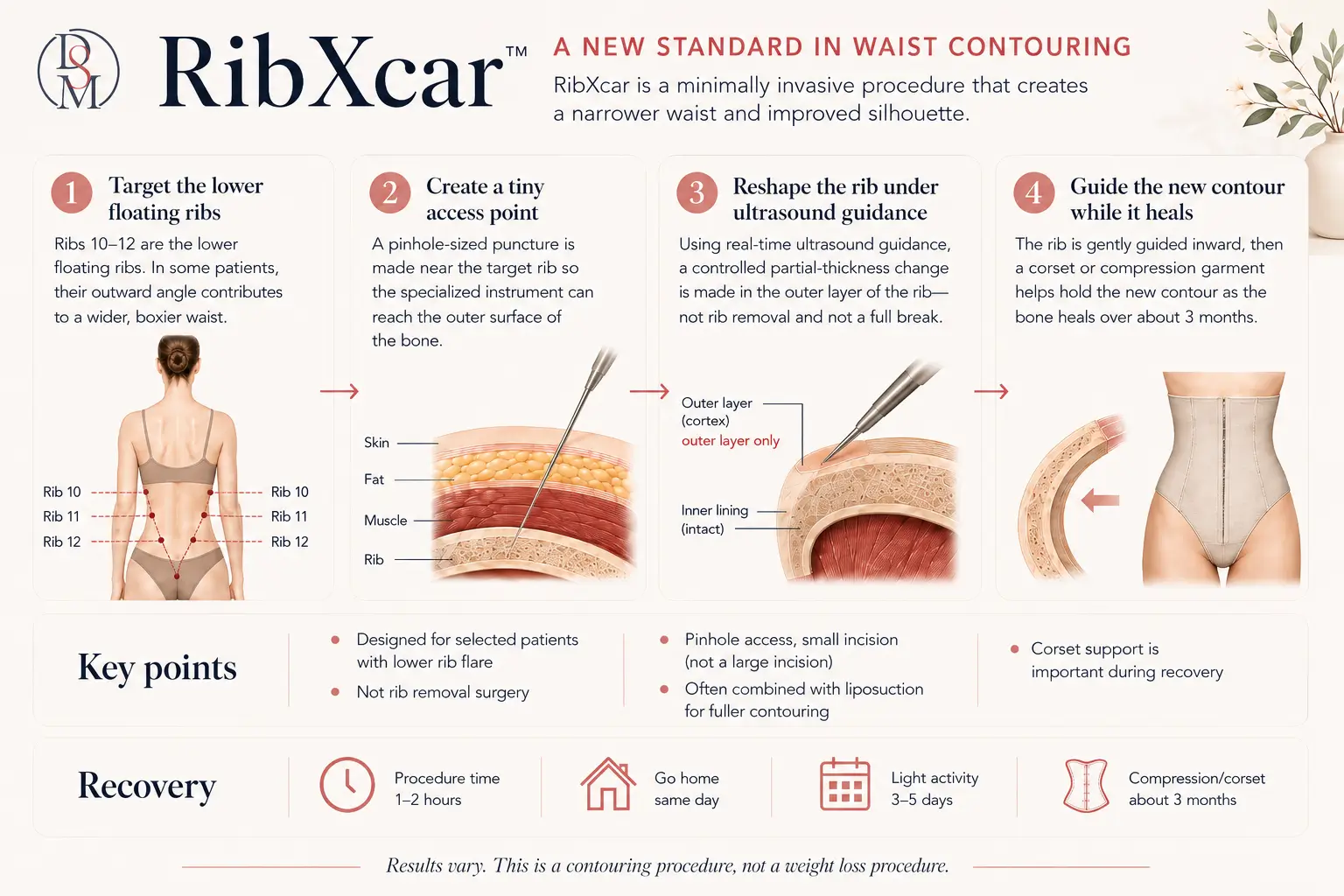
RibXcar targets the lower “floating” ribs, typically ribs 10 through 12 which, unlike the upper ribs, aren’t directly anchored to the sternum and therefore have some capacity to be reshaped.
A modified piezotome (an ultrasonic surgical instrument) is introduced through a pinhole puncture. Continuous intraoperative ultrasound lets the surgeon watch the bone in real time, using both the tactile and audible feedback of the fracture and the ultrasound image to judge when the correct degree of reshaping has been achieved. This is a nuance explored directly in Manzaneda Cipriani’s 2024 paper, which found that the sound of the fracture alone is not a reliable stopping point and that ultrasound visualization materially improves precision.
Once the ribs are reshaped, a compression garment holds them in the new position while healing occurs.
What the Safety Data Actually Shows
The most rigorous safety data available comes from a 2025 study in Plastic and Reconstructive Surgery Global Open, which surveyed 113 plastic surgeons who practice the RibXcar technique about their complication rates. A few findings stand out for anyone evaluating this procedure:
• 90% of surveyed surgeons reported no major complications. The remainder reported isolated cases of pneumothorax (a partially collapsed lung) or, less often, hemothorax (bleeding into the chest cavity) — recognized risks given the procedure’s proximity to the lungs.
• No deaths or internal organ injuries were reported among the surgeons surveyed.
• Minor complications were more common but generally resolved on their own, including temporary pain beyond the typical recovery window, minor burns from the surgical instrument, and mild asymmetry.
• Interestingly, the study found no statistically significant relationship between a surgeon’s years of experience with the technique and their complication rate. The authors instead pointed to structured, standardized training and consistent ultrasound use as the more meaningful safety factors.
• Roughly 13% of surgeons reported some recurrence of the original rib position in at least one patient, most often attributed to inconsistent use of the postoperative compression garment.
It’s worth being direct about the limitations of this data too. It’s a self-reported survey of surgeons, not a prospective clinical trial, and it captures per-surgeon rather than exact per-patient complication rates. That’s a meaningfully different (and generally more favorable) picture than an independent, patient-level outcomes registry would give, which simply doesn’t exist yet for a technique this new. Patients should treat “low complication rate” as encouraging, not as a guarantee.
RibXcar represents a genuinely less invasive evolution from older rib-remodeling and rib-removal approaches, and the emerging data suggests it’s reasonably safe in trained hands.
Who Tends to Be a Good Candidate
Based on how the technique is described in the literature and by surgeons practicing it, the best candidates are typically:
• Already lean, with the width of the rib cage. Fat or loose skin is not the primary concern
• In good general health with no history of chest trauma, thoracic surgery, or lung disease
• Looking for a refinement to an existing silhouette, often alongside liposuction or abdominoplasty, rather than a dramatic transformation from RibXcar alone
Patients whose waist concerns are actually driven by fat distribution or skin laxity are typically better served by first, or exclusively through liposuction, skin tightening, or a tummy tuck, none of which touch the skeleton at all.
Questions Worth Asking Before You Book
Given how new this technique is, and how much of its public visibility comes from social media rather than clinical channels, a few questions are worth asking any surgeon offering RibXcar:
1. What specific training have you completed in this technique, and how many cases have you performed?
2. Do you use intraoperative ultrasound guidance for every case? (The literature strongly associates this with technique fidelity)
3. What is your personal complication rate, and how does it compare to the published data?
4. What does your postoperative garment protocol look like, and why?
5. Are you board-certified in plastic surgery, and does your training in this specific technique come from a recognized course?
The Bottom Line
RibXcar represents a genuinely less invasive evolution from older rib-remodeling and rib-removal approaches, and the emerging data suggests it’s reasonably safe in trained hands. However, it is still a technique that involves controlled fracture of bone near the lungs, with real, if uncommon, risks including pneumothorax and hemothorax. Anyone considering it deserves a conversation grounded in the actual published numbers, not just the version that trends on social media.


